Showing posts with label Assassin. Show all posts

Thursday, 13 October 2011

Afro Samurai

Thankyou for voting! Here is your review!
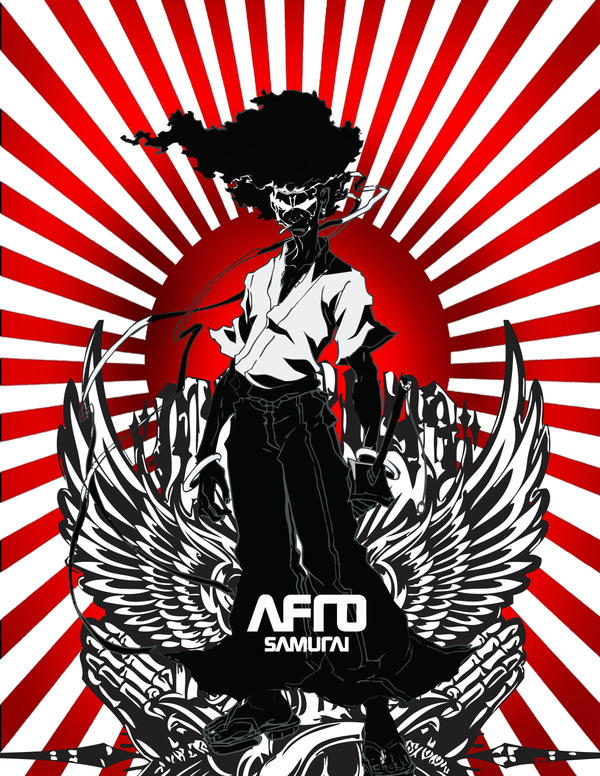

Title: Afro Samurai
Distributor: Gonzo
Genre(s): 
samurai, drama, violence

Age Rating: 18+ (extreme violence and brutal scenes)

Episodes: 5 + Movie
Aired: January 4, 2007 - February 1, 2007
Official Site: at http://www.gonzo.co.jp/index.html

Authors Rating: 9/10


Set in a world where everyone’s desire is to beat up the bigger, tougher guy in order to become the biggest, toughest guy in the ’hood, Afro Samurai serves a plate of standardised plotting. Much of the development comprises a lot of macho stand-offs followed by gruesome resolutions; furthermore, the protagonist has no other motive for his deplorable actions except revenge against the individual who killed his beloved father - the owner of the number 1 head band - when he was barely old enough to remember it.


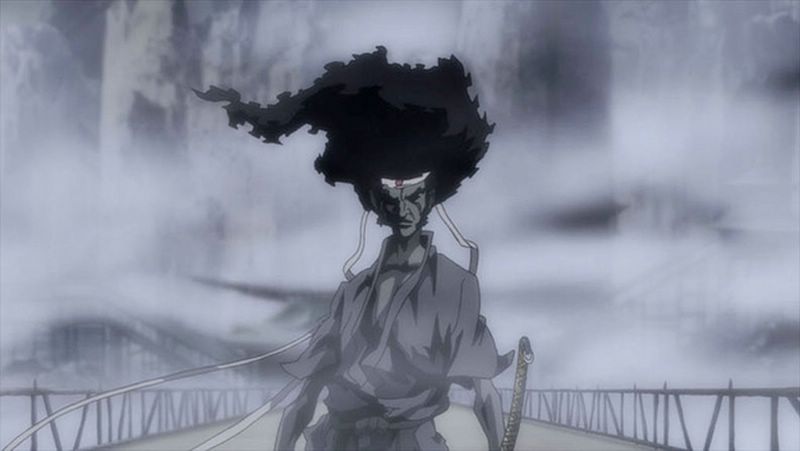
As Afro predictably hacks his way through one unfortunate challenger after another, the creative design continues to retain its fascination. Consider a irreverent world setting where rocket launchers are used in close-combat as easily as daggers - sex and violence are equally gratuitous - and the main character wears a pair of 18th century oriental bell bottoms. Even the chief antagonists are a menacing Pentecostal sect with fervent sermons drawn directly from the gospel preacher stereotype.


Afro Samurai consists of smooth, groovy, funky stuff and borrows its hard edge from African American culture in a way that brings to mind a bloodier, brawnier, but less original Samurai Champloo.


Alongside visual feasts Afro Samurai is at heart a long sequence of set pieces intentionally arranged to wow viewers who like rapid story progression, gory battle scenes and action so fast that if you blink you will miss. Afro dodges crossbow bolts, parries double swords, and carves flying bullets with the unnerving precision of a murderous master chef, all to an eerie backdrop of deep shadows, sinister greys, and hot splashing reds.


More than that, the show offers some excellent stylistic ‘comic book’ touches, from the majestic way hair floats to the ethereal fluttering of bandanna's and other loose material. Afro Samurai also makes the best use of smoke I’ve seen in Anime, including claustrophobic shots of steaming gun nozzles and cigarette fumes pumping out of nostrils, which adds to the intense 'hellish' atmosphere.


Unfortunately, stylistic excellence does not extend to the soundtrack. That is what many would tell you. I, however, completely disagree with the majority. I think the sound track is completely incomparable to Samurai Champloo's. The two Anime's are completely different. Afro Samurai is much darker and sinister. For this reason the opening music fits perfect with the dark nature of the show. If I had to compare it to Samurai Champloo I would say that I honestly preferred Afro Samurai. All that can really be said is to listen to both of them for yourself. Both Anime's have very memorable opening themes. Music within the show - Afro Samurai - has been heavily restricted and replaced by natural sounds and that add to a more eerie setting and provide a heavier atmosphere to the scenes. Music that is used is usually upon victory where our ... hero? ... Is leaving the battle field.


The men are all cold killers or shop owners, the women purely decorative, and the ham-fisted villains fall to Afro’s sword at the drop of a dismembered head. As for Afro himself, viewers need only know one thing: he’s hard. He’s so hard he could break rocks by just sitting on them. He’ll fuck a brother up quicker than he can utter ‘Yo momma’. Etcetera. In short, Afro is vacuous and only entertaining while he’s killing people; in fact, his blinkered, unrepentant lust for revenge even at the cost of allies is wholly unattractive without the necessary background substance to make it understandable.


As a pleasant surprise, the English dub consists of street lingo to match the show’s urban flair. It’s novel but it’s also rather corny. At worst, there’ll be Samuel L. Jackson’s monosyllabic deadpan performance as Afro filling up the empty scenes of the show, and making the 'lone traveller' part much more entertaining and gives the show some comic value. This character represents the internal Afro Samurai, which he suppresses but never the less is still there. 


Compact but viscerally impressive, Afro Samurai is one for the adults. It provides excellent visual entertainment and a gritty atmosphere that countless will find transiently enjoyable. Come for the style, watch for the stunts, and stay because it’s short and won’t waste too much of your time.

Friday, 7 October 2011

Elfen Lied

Title: Elfen Lied
Distributor: Arms
Genre(s): 
psychological, horror, drama, violence

Age Rating: R (extreme violence and mature scenes)

Episodes: 13 + OVA
Aired: July 25, 2004 - October 17, 2004
Official Site: at 
http://www.a-rms.co.jp/index.html

Authors Rating: 8/10


Elfen Lied's focus is the blood and gore. There is no doubt about that! The 'Diclonius', an alternate human race, provide most of our blood and gore. The rest of the blood shed is by means of a meagre military response. The Diclonius visually look similar to humans in every respect apart from two small horns protruding from their head. Lucy, our main character, is indeed one of these beings. Our anti-heroine escapes a maximum security government facility, leaving much destruction in her wake. She, like other Diclonius, is triggered into violent states, instigating the ensuing carnage. When angered she makes use of her 'vectors' - a number of invisible, extendible arms - these give her unimaginable strength. She is found naked and bloody, washed up on a beach after her ordeal. Kouta and Yuka take her in and aid her recovery, as Lucy seems to have developed severe amnesia and forgotten everything, right down to her name. The couple name her Nyuu and our story begins.


The plot is weak in places. There are minor twists and individuals suffer memory loss of significant events - often crucial to the storyline - recovered later in the anime. However, this is expected from the initial episode and continues throughout. The violence is consistent the entire anime. This could raise much discussion however I think that describing the violence is very morbid in every sense. It is safer to say the creators of the show certainly paid attention to detail when it came to death.


Nudity is very prevalent in this anime. I did not find it to be tasteless, such as in 'Gantz.' There were no violent fantasies, or uncouth happenings. There was just the female form for all to bear witness. It fits very well with the story. The scene after Lucy has escaped the research facility and how she is found is executed well. After all, why would an experimental subject require clothing? It is not as if this anime was written to be rated 12+. After reading many other reviews and seeing the complaints from these 'reviewers' I would simply refer them to the first 'Ghost in the Shell' movie - some of the greatest animation of it's time - and ask their opinion again? If it is meant to represent something then I see no reason to condemn it. Vulnerability is shown visually in this manner, as is Lucy. Beautiful but deadly.


The backdrops in this anime are fantastic. They are well drawn and demonstrate the artists attention to detail. You will not find any shoddy repetition reels here. A wide pallet of vivid colours is used not only in backdrops, but character design also.


The character design is - as many have said - very generic. I am not a fan of the children's badly proportioned eyes, nor the different drawing style for child and adult. It lacks consistency. All the Diclonius are female and have vibrant pink hair. This is never fully explained in the anime. I would assume it's primary role is for easy viewer identification of species - but where is the interest in that? I would have suggested the horns were enough. They were of heavy focus throughout. 


The development of the main characters is satisfying to watch. Nothing amazingly special. Yet the gore more than makes up for it. Lots of action - which is has a real energy and flow to it - with interesting flashbacks. Side characters have much less development - as to be expected - however a little more depth or side archs in extended episodes would have been appealing. 


Despite the mediocrity surrounding many aspects of the anime it is compelling to watch. It is unlike anything I have ever seen. The violent nature of the show grows on the viewer. Shock value becoming dark humour. Upon reflection it provoked a feeling of uneasiness that I found the violent tearing of humans amusing. The anime kept me wanting more throughout the series. At only 13 episodes there is never a dull moment. No time is wasted with the stereotypical 'filler' episodes - which is always preferable. An absolute must see for all those with a darker side.

Saturday, 1 October 2011

Death Note

Title: Death Note
Distributor: Madhouse Studios
Genre(s): mystery, supernatural, drama, fantasy
Age Rating: TVMA (violence)

Episodes: 37
Aired: October 3, 2006 - June 26, 2007
Official Site: at 
http://www.madhouse.co.jp/

Authors Rating: 9/10


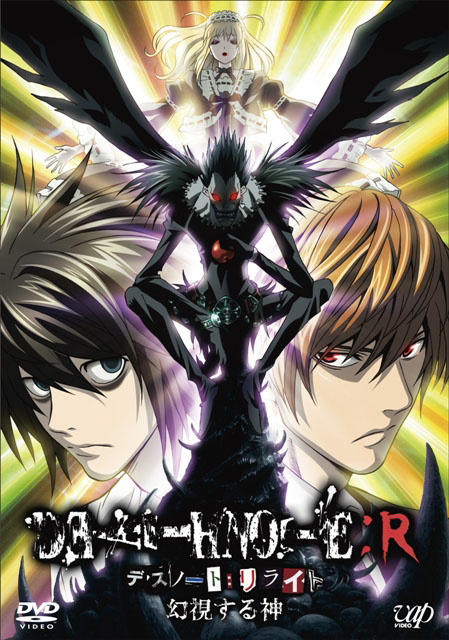
Ryuk is a Shinigami. To those of you who don't know Shinigami translates in English to 'Death God.' This particular Death God became bored of his eternal existence taking the lives of humans when their time was up, and when I say 'time is up' I mean it in a literal sense, for Death God's are only permitted to take the life of a human when fate has decided they have lived long enough. Each Shinigami has their own 'Death Note.' A death note is no more than a small black notebook that has the power to kill. If you are unfortunate to have your name written in it you will lose your life. The manner in which you do so is dependant upon the person writing your death. A simple name will result in death from heart failure, however, these deaths can be much more lavish and even impact upon the deaths of others, effectively taking control of the individual named. One particular Shinigami, due to his lack of excitment decides to play a game where by he will be the observer. Ryuk drops his Death Note in to the human world straight in to the path of our main character, Light Yagami. 


DeathNote_How To Use It

Death Note is the most thrilling, psychological and mentally engaging anime I've ever watched. There are 37 episodes and each builds on the pressure of the previous. A cat and mouse chase right to the end.


The story focuses on a top university student Light Yagami who discovers the 'Death Note', a notebook dropped by a death god named Ryuk. The Death Note grants its owner the power to kill anyone just by writing their name on the book. It also has the ability to give the user a power which enables them to see name of their proposed victims floating above their heads. It's the perfect killing device.

Light Yagami decides to serve justice by passing judgement upon those deemed evil through using the death note. He starts by testing the powers of the death note on convicted criminals that have been sentenced to death, but later, as many do, becomes addicted the power it gave him and starts to take the lives of more and more people for less and less, invoking fear in to the general public. As more die under his silent rule, the police are having a hard time with their investigations as there is no evidence of a criminal, except that those convicted or with a criminal history just keep dying of the same cause, a heart attack. As fate would have it our main character's father is a high ranking inspector in the local police force, yet Light is always one step ahead. Due to the lack of leads the police have to hire in external help. Enter 'L' our teenage secret detective who has never failed to solve a case and only takes up those that interest him. The psychological battle begins and a silent war is waged between the two characters. Who will come out on top? Light or 'L'?
Many interesting characters are introduced later on and the story spans a few years. The evolving character of Light with his views on morality and justice is thought provoking. The plot is so controversial that it was banned in China to protect the "physical and mental health" of students.
The whole series is about battles of wits, mind games and traps. In each episode, viewers are shown rules of using the Death Note. These are the rules of the killing game, rules that the police have to figure out themselves in order to solve the puzzle, to nail down Light.
The popularity is probably due to how intellectual the series is. It is very involving and challenges the audience to stay ahead by constantly guessing the next move, wondering what Light will do.
Even if you're a not manga or anime fan, you should definitely check out Death Note. It's an amazing anime that will leave you wanting more when it ends.

Thursday, 29 September 2011

Phantom: Requiem of the Phantom

Phantom: Requiem for the Phantom
Title: Phantom: Requiem for the Phantom

Distributor: FUNimation Ent. 
Genre(s): crime, drama, action
Age Rating: TVMA (violence)

Episodes: 26
Aired: Apr 2, 2009 to Sep 24, 2009
Official Site: at www.FUNimation.com


Authors Rating: 7.5/10


Anime is no stranger to violence or death. It's most popular market has been dominated by it, with titles such as DragonballHellsing, and Elfen Lied, there is no shortage of protagonists and villains that are straight-up, bad-ass killing machines. 


But when do the viewers stop to question the morality of such acts? Indeed, when does anime ever seriously focus upon what this violence creates and the impact upon those who carry out such heinous acts. We as viewers never really think about such things, and instead relish upon the intense fight scenes and dynamic animation of the impossible becoming for a short time reality... Here we have something special, something unique. I give you 
Phantom: Requiem for the Phantom an anime unlike the author has ever seen that asks the question ''What does it mean to kill?'' 


We begin with a young Japanese student, who after an unfortunate series of events, inadvertently steps on the toes of Inferno, a worldwide criminal empire. Self-dubbed the "United Nations of Crime," Inferno lives up to its name; anyone, and they mean anyone, who doesn't play by their rules gets reduced to ashes, both figuratively and if necessary, literally.


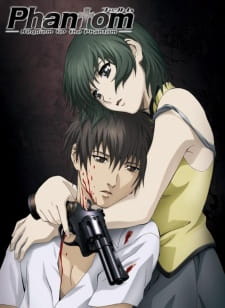
Inferno becomes aware of the young boy after he witnesses the assassin Ein, a young girl trained by the criminal syndicate, killing an American reporter who managed to dig up some dirt on them. Scared for his life, the young boy runs from the masked girl, and actually manages to elude her for quite some time. This feat, unheard of for anyone Ein is assigned to kill, impresses the Scythe Master, Ein's trainer and master.


Drawn to the boy's "perfect survival instinct," Scythe Master decides to spare the boy's life and make him a Phantom, the world's deadliest assassin, second only to Ein. Erasing his memory and giving him the codename Zwei (German for "two"). He, along with Ein ("one") make up Phantom, Inferno's deadly assassins who eliminate anyone they deem to be a hindrance to their organization. They are so feared that even a mention of their name is enough to make people step in line and sing to Inferno's horrible, wretched tune.


What then follows in Phantom: Requiem for the Phantom, is a sequence of missions in which Zwei becomes accustomed to his new life as a heartless killer. However, he continuously questions why he is doing the horrid tasks given to him, as well as grows close to Ein. Eventually deciding he doesn't belong to Inferno (despite their grave misgivings), he escapes the organization with Ein in tow. Inferno of course goes after them, but being the most skilled killers on Earth has its fringe benefits, as both Ein and Zwei fight off Inferno as well as discover their true identities.